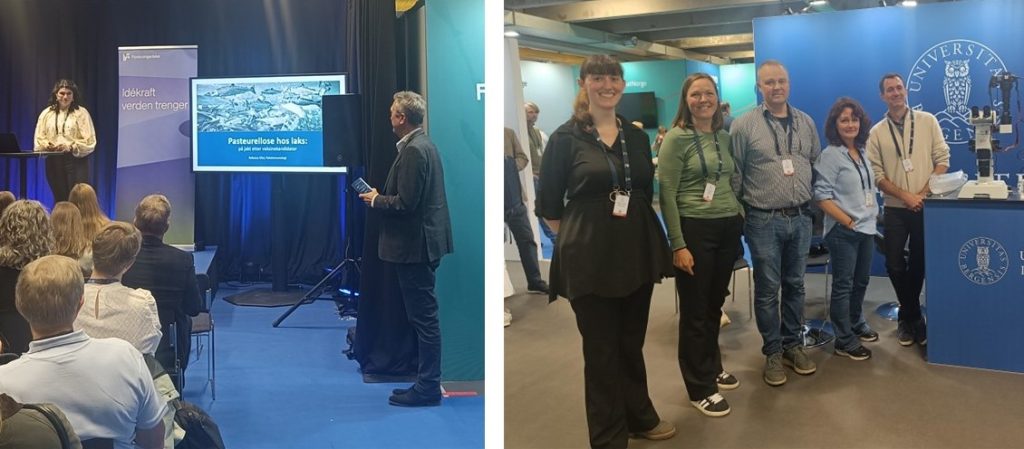
As I write this, I’m sitting at a booth in Trondheim at the aquaculture fair Aqua Nor, surrounded by the entire aquaculture industry — from fish farmers, vaccine companies, wellboat owners, cage suppliers, economists, the Crown Prince (yes, he actually stopped by), to diesel generator salespeople. As a biologist, this can be intimidating, since our areas of interest often differ somewhat. So this year, we brought the salmon louse as a link between the commercial and academic worlds, transported in a freezer and rental car over the beautiful Sognefjellet, and displayed at the booth with a magnifying glass and a 42-inch TV screen.
This has been very effective, and many have stopped by, received a quick introduction to louse anatomy, and then we’ve discussed more or less relevant solutions to the salmon lice problem and other important global issues. Not least, we’ve gained a lot of new knowledge about an industry in constant development, which can now be incorporated into teaching.
In these discussions, AI is increasingly being mentioned. With over two million fish at each facility, AI is something the aquaculture industry will greatly benefit from — for example, in image analysis, which is already widely used. It can provide fish farmers and fish health biologists with better tools to ensure good fish welfare and prevent disease outbreaks, resulting in less suffering and a more sustainable industry.
However, AI has high water and energy consumption — resources the world doesn’t have an unlimited surplus of — and we might need to be a bit critical of how we increasingly use AI in everyday life. The use of AI can be justified if it helps streamline and improve food production, but for instance, my travel companion over the mountains on Monday was asking Gemini all sorts of questions that popped up during our journey northward.
When we specifically asked this somewhat underdeveloped AI tool what caused the turquoise color of the lakes in Sognefjellet, it answered that it was the algae Emiliania huxleyi. Naturally, we followed up by asking whether Emiliania huxleyi lives in freshwater, to which it replied no, only in seawater.
How we can implement AI in higher education is also being looked at these days, where AI teething problems like those Gemini clearly has could be catastrophic for an unfortunate student. A national committee has been established, and input is now being accepted on how AI tech can assist us with exams and assessments, adaptation of learning objectives, etc.
As a notoriously technologically backward person, I’ll probably be one of the last to nervously venture into the AI ballet, and I’ve actually been a bit worried about it. Am I falling behind as a teacher and researcher? Will I be outcompeted and seen as outdated? And not least — will I be too unproductive without an AI colleague?
But maybe it’s just as well that some of us are a bit slow. After all, it’s also important to give students generic skills like the ability to concentrate and delve into various time-consuming tasks. Only then will we be prepared when an AI bot tries to take over the world!”** This text is translated by copilot and has not been proofread by me. If you think some words are strange, ask a Norwegian friend
Hilsen Aina
Aina-Cathrine Øvergård
Faggruppe fiksehelse (Fish health group)