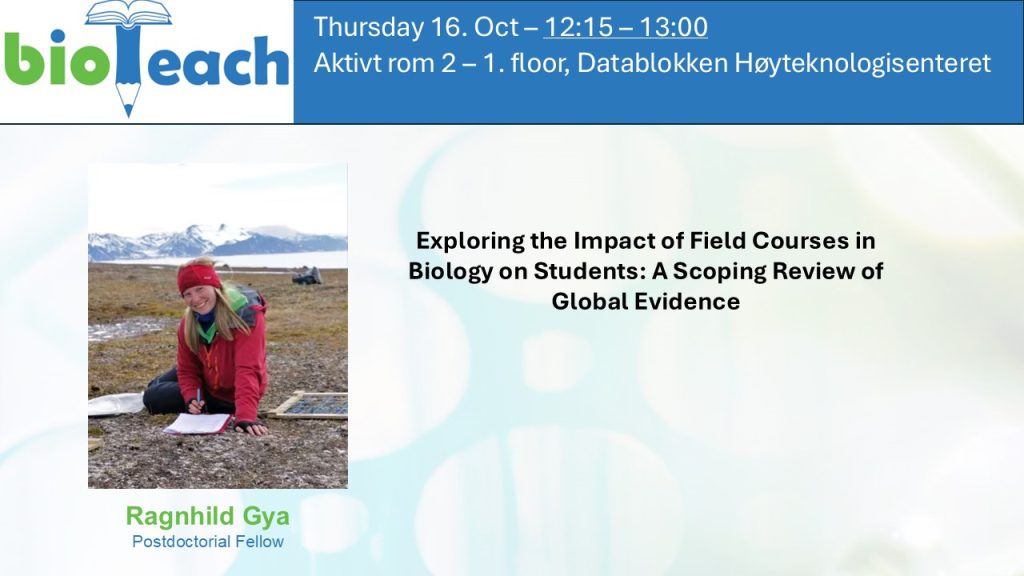
Ragnhild Gya – Exploring the Impact of Field Courses in Biology on Students: A Scoping Review of Global Evidence
Exploring the Impact of Field Courses in Bioloy on Students: A Scoping Review of Global Evidence
Ragnhild Gya, Pascal Schaldach, Pernille Bronken Eidesen, Maria de Jesus, Anne Bjorkman and Jorun Nyléhn
Abstract
Field courses have long been a cornerstone of biology education, offering students immersive, hands-on experiences that bridge theory with real-world applications. Despite their potential to enhance student’s understanding of biological topics, these courses are increasingly at risk due to, for example, budget constraints. Valid criticism highlights the need for careful planning to maximize learning outcomes. Beyond academic benefits, field courses can also foster peer connections, motivation, and environmental stewardship—a critical outcome in the context of the biodiversity crisis.
To map documented outcomes, we conducted a global scoping review of field courses on biological topics for students from upper secondary to graduate levels. We summarize research from 2000–2024, examining where courses occur, their duration, and the system and organisms in focus. In a second step, we select the studies that have control groups and document the findings from these studies in more detail. During this talk I will present the preliminary findings from this literature review.
An initial view of the results show that field courses do indeed impact grades, motivation, sense of belonging (both to other students and nature), and retention rates. We also document a recent boom of research on inclusive field courses, incorporating local knowledge (e. g., indigenous perspectives), and comparing outdoor field courses with digital alternatives, and digital tools in field courses. Parts of the presentation will be interactive where we discuss the main topics of the current literature on field courses, and the way forward in research and teaching.