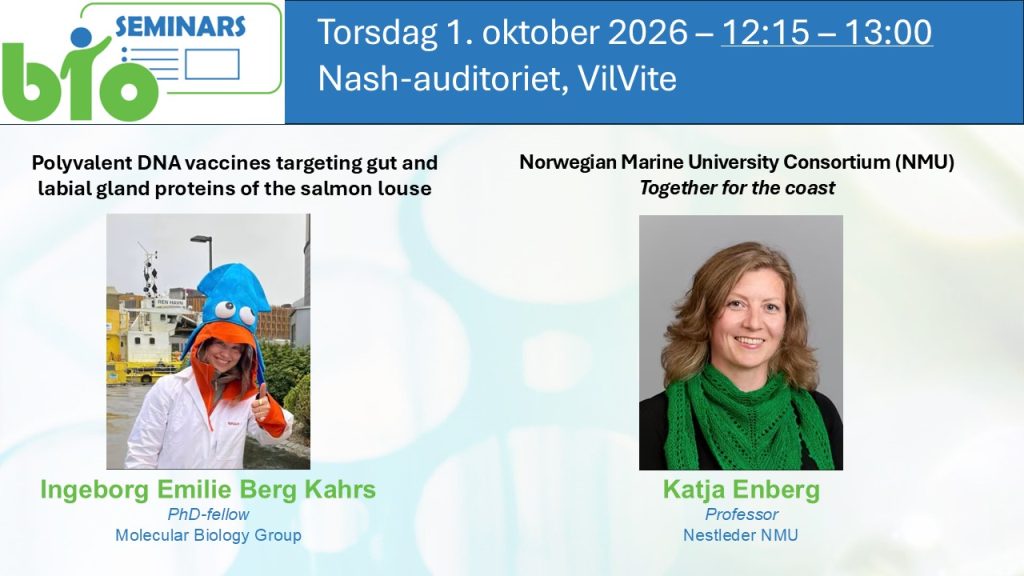
- Thursday 1. October
- 12:15-13:00
- Nash-auditorium, VilVite
Ingeborg Emilie Berg Kars: Polyvalent DNA vaccines targeting gut and labial gland proteins of the salmon louse
The salmon louse (Lepeophtheirus salmonis) is a parasite that causes significant biological and economic challenges in Norwegian aquaculture. The parasite releases immunomodulatory proteins on the surface of Atlantic salmon (Salmo salar), allowing it to evade the host’s immune system and promote infection. Targeting these proteins with vaccination could improve salmon immune responses and decrease infections. In addition, targeting antigens in the gut of the salmon louse has been considered promising given the great success of the vaccine protecting cattle against ticks (Boophilus microplus). Combining several antigens in a vaccine can be easily and affordably done using DNA vaccines.
In this study, polyvalent DNA vaccines encoding selected gut and labial gland proteins were tested in an infection trial and evaluated by measuring gene expression, antibody production and a final lice count.
The vaccines did not result in any difference in lice numbers. However, there was a significant production of selected antibodies. In conclusion, further optimisations of the vaccines are needed to achieve protection against salmon lice infection.
Katja Enberg: Norwegian Marine University Consortium – together for the coast
- NMU is Norway’s representative of the higher education sector to the European Marine Board (EMB), and the Scientific Committee on Oceanic Research (SCOR), and facilitates the Norwegian participation in processes initiated and led by EMB and SCOR.
- NMU promotes cooperation in marine and maritime research, education and infrastructure among its members.
- NMU contributes to the discussions on science policy regarding marine and maritime issues to national and international ministries and organizations.
- Through joint research initiatives, NMU will help advance marine and maritime research and innovation and contribute to an exchange of knowledge and resources.
We are now in the process of renewing the consortium agreement for another 5 years. The board proposes that NMU, building of the network and experiences gathered during our first five years, shall move into a more practical and action oriented phase, with the coast as our focal point. We aim to facilitate coordinated research initatives and actions adressing questions araising from the many and fast changes our coastal environments are subject to. Ultimately we will endevour to raise political support for a national program involving all relevant research communities – not limited to the NMU members, to address the current challenges our coastal environments are facing.