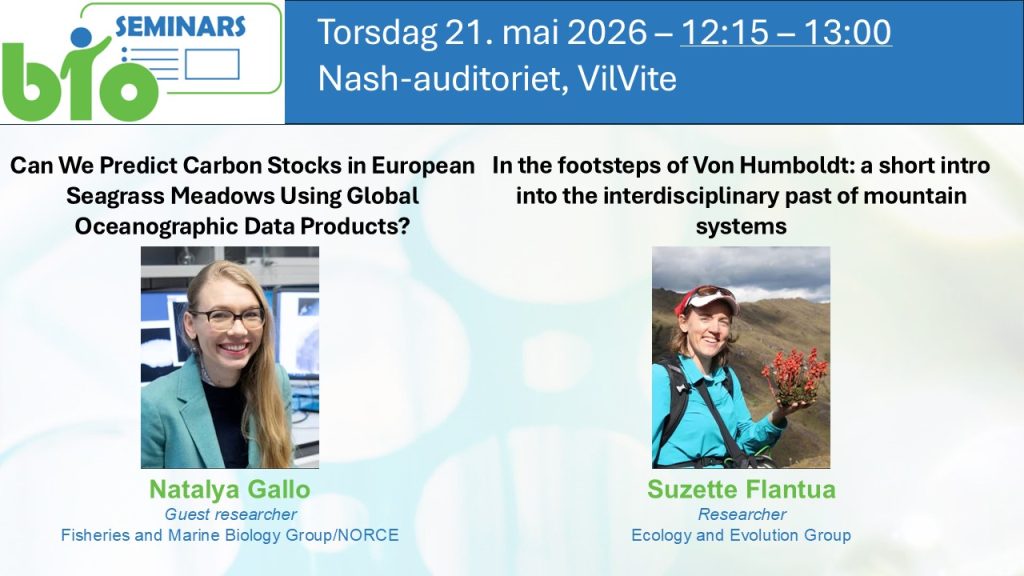
- 12:15 – 13:00
- Nash-auditorium, VilVite, 2nd floor, Thormøhlensgt. 51
Suzette Flantua: In the footsteps of Von Humboldt: a short intro into the interdisciplinary past of mountain systems
Inspired by the journeys of Von Humboldt, this talk explores how mountain systems can only be understood by integrating the atmosphere, cryosphere, geosphere, and biosphere as one connected system. Using examples from mountain regions around the world, I will show how glaciers, climate fluctuations, and ecosystem dynamics have continuously reshaped alpine environments over thousands of years. I will introduce the interdisciplinary work of the Mountains in Motion Research Team, which combines ecology, evolution, climate, glaciology, geography, and remote sensing to reveal how mountain landscapes and biodiversity evolves through time.
Suzette Flantua is a researcher and holder of a Trond Mohn foundation starting grant with the Ecology and evolution academic group [faggruppe] and the Terrestrial ecology research group, both at the Department of Biological Sciences.
Natalya Gallo: Can We Predict Carbon Stocks in European Seagrass Meadows Using Global Oceanographic Data Products?
Seagrass meadows are coastal marine ecosystems that remove atmospheric carbon dioxide through photosynthesis and store autochthonous and allochthonous carbon in sediments. Despite their importance as “blue carbon” ecosystems along European coastlines, seagrasses are rarely included in national climate plans, partly due to difficulties in mapping carbon stocks at scale. The MARCO-BOLO Horizon EU project aims to strengthen coastal, marine, and freshwater biodiversity observing in support of decision making. As part of this project, we examined how remote sensing can support European needs for blue carbon mapping. Here we test whether oceanographic data products, including remote-sensing-derived variables, can predict seagrass sediment organic carbon stocks. Environmental drivers of carbon storage were identified, and datasets from NASA and Copernicus were spatially matched with seagrass sediment carbon measurements from the EURO-CARBON database. A suite of machine learning models were trained to predict carbon density in seagrass sediment cores. Incorporating oceanographic data products substantially increased model performance. Carbonate chemistry, nutrient, and hydrodynamic energy variables emerged as key predictors. The highest performing model, a Gaussian Process Regressor (GPR) was used to predict carbon stocks across all European seagrass beds based on known seagrass extent from the seagrass Essential Ocean Variable. Beyond the project scientific results, I will also discuss how a co-design process with stakeholders was implemented throughout the process to align the scientific approach with policy and management needs. The outcome resulted in a virtual research environment which allows users to estimate carbon stocks by providing seagrass bed coordinates and species identity. This tool addresses growing needs for scalable blue carbon mapping in Europe and demonstrates how global data products can support these efforts.
Natalya Gallo is a researcher at NORCE and is affiliated with the Department of biological sciences as a guest researcher with the Fisheries and marine biology academic group [faggruppe] and the Fjord and coastal ecology research group.